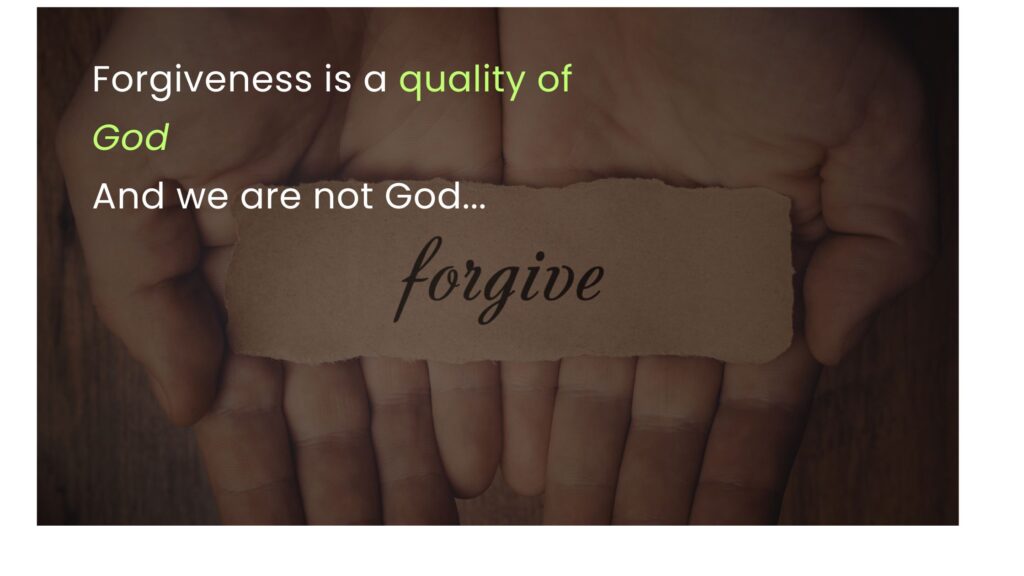
People say “forgive” as if its soo easily.
Almost carelessly.
As if forgiveness is some switch you can flip once you’ve cried enough or thought about it long enough.
But tell me
How do you forgive someone who caused damage that can’t be undone?
Damage that didn’t just hurt you but shook your entire sense of self… your identity, your confidence, your self-respect?
And what about the cases no one talks about when the person who hurt you isn’t even sorry?
No apology.
No regret.
No awareness of the mess they left behind.
How exactly are you supposed to forgive then?
I asked myself these questions for years.
Not quietly. Not gracefully.
I fought with them. I resisted them. I stayed angry because anger felt more honest than pretending to be “healed.”
What I didn’t understand back then is this forgiveness has very little to do with the other person.
For a long time, forgiveness felt unfair. Almost insulting. Like something expected from the wounded so everyone else could be comfortable.
It’s not about excusing what they did.
It’s not about saying it was okay.
And it’s definitely not about pretending you weren’t affected.
Some things change you forever.
And acknowledging that doesn’t make you weak it makes you real.
Forgiveness, as I’ve come to understand it, is a decision you make for yourself.
It’s the moment you realize : I don’t want this to run my life anymore.
Because when someone hurts us deeply, they don’t just hurt us once. They stay with us in our thoughts, our triggers, our reactions, our guardedness. They keep controlling our inner world long after they’ve exited our life.
Forgiveness is when you gently — and sometimes angrily — take that control back.
It’s when you stop waiting for an apology that may never come.
When you stop hoping they’ll finally understand.
When you stop tying your healing to their growth.
You don’t do it because they deserve forgiveness.
You do it because you deserve peace.
Now here’s the uncomfortable part.
Staying in victimhood can feel safer than we admit.
There’s sympathy there. Validation. A sense of being seen. And when you’ve been deeply hurt, that validation matters.
There’s nothing wrong with acknowledging the pain.
But there’s a difference between honouring your pain and living in it.
At some point, the victim story stops protecting us and starts limiting us.
We sit on the victim chair not because we want to suffer, but because we’re scared of who we’ll be if we let the story go. Because healing means responsibility. It means choosing again. It means standing up.
Forgiveness is that moment when you stand up.
Not because you’re “over it.”
But because you’re tired of being defined by it.
You realise: This happened to me but it doesn’t get to decide who I become.
You are not what was done to you.
You are not the betrayal, the abandonment, the loss, the damage or the disrespect.
You are what you choose to create after it.
This is where forgiveness quietly turns into power.
When you stop asking, “Why did this happen to me?”
and start asking, “What is this teaching me about my strength?”
Most of the time, the situations we think are against us are actually forcing us to meet parts of ourselves we never had to meet before. Our boundaries. Our resilience. Our ability to choose ourselves.
Growth rarely comes wrapped in comfort.
It usually arrives disguised as heartbreak.
Forgiveness doesn’t mean forgetting.
It means remembering without bleeding every time.
Some days, forgiveness is calm.
Other days, it’s messy and ongoing. Some days, it’s simply choosing not to reopen the wound.
And that’s okay.
Forgiveness is not weakness.
It’s not submission.
It’s not letting anyone “win.”
It’s freedom.
Freedom from carrying the past into every present moment.
Freedom from letting someone else’s choices decide the quality of your life.
And the truth is no one can force you into forgiveness.
It comes only when you’re ready.
But when it does, it’s not loud or dramatic.
It’s quiet.
Grounded.
And deeply yours.