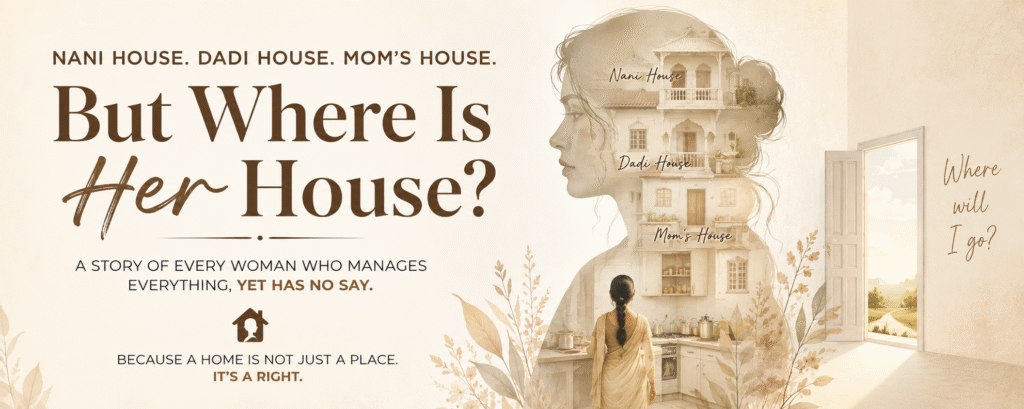
Nani House. Dadi House. Mom’s House. But Where Is Her House?
We all grow up hearing these words with warmth and nostalgia.
“Let’s go to Nani’s house.”
“We’re visiting Dadi’s house.”
“Mom’s house is always open for everyone.”
But have we ever paused to ask a simple question?
Was it ever truly their house?
A woman spends her life moving between homes that are supposedly hers. First, her parents’ home. Then, her husband’s home. Later, her children’s home. Every place is named after her, associated with her love, her care, her presence.
Yet somewhere deep inside, many women carry a question they rarely say aloud:
“If not here, then where will I go?”
Think about that for a moment.
The woman who knows where every document is kept.
The woman who remembers everyone’s birthdays, medicines, appointments, allergies, and preferences.
The woman who plans the meals, manages the relationships, keeps peace during conflicts, cares for the sick, celebrates everyone’s achievements, and absorbs everyone’s disappointments.
She is the manager, the caretaker, the emotional backbone, the invisible CEO of the household.
Yet when decisions are made, she is often informed rather than consulted.
Because she is not the earning member. Or perhaps she earns, but not as much. Or perhaps her labour is simply not counted because it does not arrive in the form of a salary slip.
The irony is heartbreaking.
The person carrying the weight of the house often has the least authority within it.
And so generations of women have lived with an insecurity many men never have to experience—the fear that their place in the world is conditional.
A man’s home is assumed to be his.
A woman’s home is often something she must continuously earn through service, sacrifice, obedience, and adjustment.
This is not a conversation about femininity.
This is a conversation about patriarchy.
A system so deeply woven into our lives that we mistake it for tradition.
Why is caring for a man considered a woman’s duty, while caring for a woman is viewed as a favour?
Why are men’s opinions expected and women’s opinions optional?
Why are women trusted with responsibilities but denied authority?
Why is management hers, but ownership someone else’s?
And perhaps the most uncomfortable question of all:
Who keeps this system alive?
It would be easy to point fingers only at men.
But patriarchy survives because generations have learned to protect it—sometimes knowingly, sometimes unknowingly.
Women who were denied freedom may deny it to younger women.
Women who were silenced may become uncomfortable when another woman speaks too loudly.
Women who were judged may become judges themselves.
Because pain, when left unhealed, often disguises itself as tradition.
“What was forbidden for me must remain forbidden for you.”
And so the cycle continues.
A girl dares to dream differently.
People question her character.
A woman sets a boundary.
People call her selfish.
A wife asks for equality.
People call her difficult.
A mother chooses herself.
People call her irresponsible.
The message remains the same:
Know your place.
And yet, despite centuries of criticism, women continue to rise.
They study, work, lead, create, nurture, build businesses, raise families, and hold communities together.
Not because they are allowed to.
But because they are capable.
The real question is not whether women deserve a place.
The real question is why we still live in a world where they are made to feel they must ask for one.
Maybe true progress will begin when a woman no longer fears the question, “Where will I go?”
Maybe it will begin when a daughter grows up knowing she belongs wherever she chooses to stand.
Maybe it will begin when homes stop being places where women serve and start becoming places where women belong.
Because a house is not defined by who pays for it.
A house is defined by who builds its soul.
And if love, labour, care, sacrifice, and emotional strength are the foundations of a home, then women have been homeowners for generations.
It’s time society recognized it too.